
Taking the leap from a purely digital operation to a physical storefront is one of the most exhilarating milestones an entrepreneur can experience. Outgrowing your garage, spare bedroom, or third-party fulfillment center is a massive indicator that your brand has achieved genuine resonance with your target audience. Seeing your products beautifully displayed in a physical space, watching customers interact with your merchandise in real time, and handing a branded shopping bag to a happy buyer provides a level of tangible satisfaction that e-commerce simply cannot replicate.
However, making this transition requires a profound shift in how you operate your business. The physical retail landscape is unforgiving to those who enter it unprepared. In the digital world, a poorly performing marketing campaign can be paused with the click of a button, and a website redesign can be deployed over a weekend. In the physical world, mistakes are infinitely more expensive and time-consuming to correct. You are trading flexible, variable digital costs for rigid, fixed physical overhead. Rent, utilities, insurance, physical security, and in-person payroll do not pause just because foot traffic is slow on a Tuesday.
To succeed in this new environment, you must approach your expansion with cold, calculated logic. The charm of having a physical shop must be balanced by an ironclad operational strategy. You are no longer just an e-commerce manager; you are about to become a facility operator, a local marketer, an inventory logistics coordinator, and a community fixture.
The purpose of this comprehensive guide is to walk you through the precise, chronological steps required to bring your digital brand into the physical world successfully. From stress-testing your finances to designing an optimized floor plan and maintaining daily operations, this breakdown will equip you with the knowledge to open your doors with confidence and build a sustainable, profitable physical presence.
Evaluate Your Financial Strategy and Location Type
Before you even begin looking at physical spaces, you must conduct a rigorous financial stress test on your current business model. In e-commerce, your costs scale relatively predictably with your sales volume. Physical retail, however, introduces a massive baseline of fixed monthly expenses that must be paid regardless of whether a single customer walks through your door. You need to calculate your exact break-even point in this new paradigm. Determine exactly how many units you must sell per day just to keep the lights on, pay your staff, and cover your physical overhead. You should have a minimum of six to twelve months of this operating capital saved in cash reserves before committing to a physical space, as it takes time to build local awareness.
Once your financial foundation is secure, you must define your location strategy based on your specific business model. There are generally two types of retail strategies: destination retail and impulse retail. If you have a massive, highly loyal online following that will gladly drive thirty minutes out of their way to visit you, you can opt for a destination model. This allows you to look at spaces in slightly off-the-beaten-path neighborhoods or industrial parks where the cost per square foot is significantly lower. Conversely, if your product relies on impulse buys, foot traffic, and visual discovery, you will need to pay a premium for a high-street location, a mall, or a bustling downtown district.
When evaluating spaces, you will face the critical decision of how to acquire your location.
Here are the primary pathways and what you should consider for each:
-
Building Long-Term Equity: If you have substantial capital and want to stabilize your long-term monthly costs against inflation, looking for commercial real estate for sale might be your best route. Purchasing your location outright or with a business loan turns your monthly payment into an investment in a tangible asset, allowing you to eventually borrow against the equity or sell the building for a profit. However, this ties up a massive amount of liquid capital that could otherwise be used for inventory or marketing.
-
Maintaining Operational Agility: For most first-time physical retailers, the smartest path is finding a commercial property for lease that fits their current budget while allowing room for immediate growth. Leasing keeps your initial startup costs dramatically lower, preserves your cash flow for daily operations, and gives you the flexibility to relocate when your lease expires if your business outgrows the square footage or the neighborhood demographics shift.
-
Analyzing Hidden Costs: Regardless of the path you choose, you must account for localized costs such as property taxes, municipal waste removal fees, and mandatory local business association dues, all of which will impact your bottom line.

Secure Legal Counsel and Clarify Landlord Dynamics
Entering the world of physical retail introduces you to a new realm of legal and contractual obligations. One of the most dangerous assumptions a new business owner can make is treating a business lease like a residential apartment lease. Residential leases are heavily regulated by consumer protection laws designed to keep tenants safe. Business leases, on the other hand, are viewed by the law as agreements between two sophisticated corporate entities. There are very few built-in protections for the tenant, and almost every single clause in a standard contract is heavily weighted in favor of the landlord.
You will encounter complex financial structures like the Triple Net (NNN) lease, where you are responsible not only for your base rent but also for your proportional share of the building’s property taxes, building insurance, and structural maintenance. You might also face Common Area Maintenance (CAM) fees, which cover the upkeep of shared parking lots, landscaping, and exterior lighting. If these clauses are not capped or strictly defined, a sudden roof repair on the building could result in a massive, unexpected bill for your business.
To protect yourself from predatory terms, you must take the following steps:
-
Hire Specialized Representation: Never sign a binding multi-year document without having a real estate attorney review every single page. They will redline the contract to cap your CAM fees, negotiate your build-out allowances (money the landlord gives you to renovate), and ensure there is a “use clause” that prevents the landlord from renting the space next door to your direct competitor.
-
Understand Zoning and Permitting: Your legal counsel will also help you verify that the space is correctly zoned for your specific operations. If you plan to manufacture products on-site, serve food, or host large events, you must ensure the municipal zoning laws permit these activities in that specific building.
-
Establish Communication Protocols: Once the lease is signed, you need to understand exactly how the building is run on a daily basis. You need to know if you are dealing directly with an owner or if you must route all maintenance requests, security concerns, and billing questions through a designated property manager who oversees the daily operations of the complex. Knowing your exact point of contact for emergency repairs (like a burst pipe at 2:00 AM) is critical for preventing catastrophic inventory loss.
Optimize Your Layout for Inventory and Customer Experience
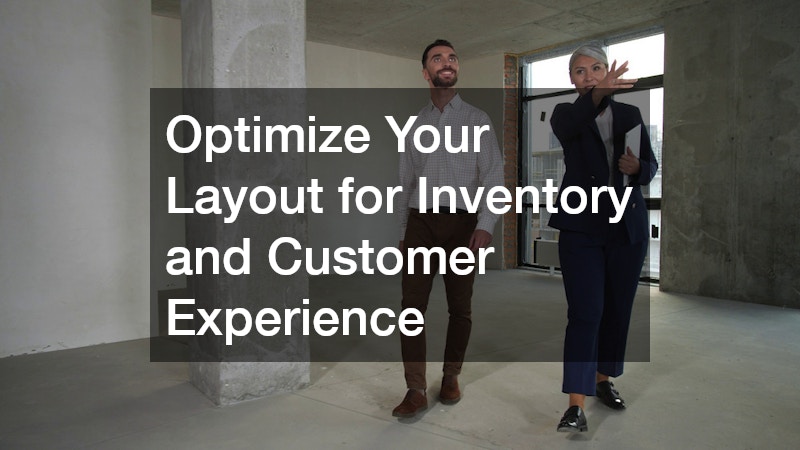
Once you have the keys to your new space, you are faced with a blank canvas. It is incredibly tempting to rush to the local hardware store, buy some basic shelving, and start putting products on the floor. However, retail design is a highly researched science, and the physical layout of your store directly dictates your sales volume. Every square inch of your floor plan must be intentionally designed to guide the customer journey, highlight high-margin products, and facilitate efficient backend operations.
The moment a customer walks through your door, they enter the “decompression zone.” This is the first five to ten feet of the store where the customer is mentally adjusting to the new lighting, music, and spatial dimensions. Customers rarely notice products placed in this zone. Instead of cluttering the entrance, use this space to set the aesthetic tone of your brand. Furthermore, retail psychology shows that the vast majority of right-handed customers will naturally drift to the right side of the store upon entering. This “power wall” should house your most visually striking, high-margin, or newly launched products.
Simultaneously, you must design a space that supports your ongoing digital success. Opening physical doors does not mean you abandon your e-commerce roots; it means you are now operating an omnichannel business.
To master this hybrid approach, consider these structural strategies:
-
Omnichannel Fulfillment: Do not allocate 100% of your square footage to the retail floor. You must partition a secure, organized section in the back to act as a small warehouse where you can process online orders, store surplus inventory, and facilitate “Buy Online, Pick Up In Store” (BOPIS) transactions without disrupting the flow of the retail floor.
-
Professional Space Planning: Because balancing retail aesthetics with operational logistics is complex, it is highly recommended to partner with a commercial design and build firm. These professionals will handle the architectural drawings, secure the necessary municipal permits, and manage the general contractors to ensure your walls, lighting grids, and custom fixtures are built to code and perfectly align with your brand’s visual identity.
-
Point of Sale (POS) Integration: Your physical layout must accommodate a streamlined checkout experience. Ensure your counters are hardwired with reliable, dedicated internet lines to support cloud-based inventory systems that sync your physical register sales with your digital website inventory in real time.
Maximize Curb Appeal to Drive Immediate Foot Traffic
You can curate the most beautiful, optimized interior space imaginable, but it will be entirely useless if the exterior of your building fails to draw people inside. In physical retail, curb appeal is your most powerful, localized marketing tool. The exterior of your business must instantly communicate what you sell, who your target demographic is, and the level of quality they can expect inside. You have approximately three seconds to capture the attention of a passing driver or pedestrian. If your exterior is confusing, uninviting, or visibly neglected, potential customers will simply walk past your doors and take their money elsewhere.
The psychology of transparency plays a massive role in foot traffic. Human beings are naturally hesitant to enter enclosed, mysterious spaces. If your windows are heavily tinted, covered in cheap promotional posters, or blocked by tall shelving units, you create a psychological barrier. Modern retail thrives on bright, unobstructed sightlines. People want to look through the glass, see other customers shopping, observe the lighting, and get a feel for the vibe before they commit to walking in.
To ensure your exterior is working tirelessly to acquire new customers, execute the following upgrades:
-
Branded Visibility: Do not rely on temporary banners or cheap window decals to announce your presence. You must invest heavily in a permanent, professionally fabricated storefront sign that is illuminated, easy to read from a distance, and strictly adheres to your brand’s typography and color palette. This is often the first physical touchpoint a customer has with your brand.
-
Exterior Audit: Walk past your location during the day, at dusk, and late at night. Check for dark spots near the entrance that might make the space feel unsafe. Ensure your exterior facade is freshly painted, the sidewalk is swept, and there is no lingering debris near your front door.
-
Glass Integrity: The windows are the eyes of your business. If the glass is heavily scratched, vandalized, or suffering from blown seals that leave a permanent, foggy condensation between the panes, it severely degrades your brand’s perceived value. You must contract professional storefront glass services to repair or entirely replace compromised windows, ensuring your display areas are crystal clear, secure, and energy-efficient.
Establish Standard Operating Procedures for Daily Upkeep
The most unglamorous, yet fundamentally crucial, aspect of running a physical location is daily maintenance. When you operated solely online, the cleanliness of your fulfillment center only mattered to you and your employees. In the physical world, the cleanliness of your facility is directly tied to the perceived value of your products. If a customer walks into your beautifully designed shop but notices dust thick on the shelves, smudged mirrors in the fitting rooms, or a restroom that smells unpleasant, their perception of your brand plummets instantly. Premium price points demand premium, impeccably maintained environments.
Maintaining this standard requires the implementation of strict Standard Operating Procedures (SOPs) long before opening day. You cannot rely on an ad-hoc approach to cleaning, assuming someone will grab a broom when things look dirty. You must create itemized daily, weekly, and monthly checklists. Daily tasks include wiping down point-of-sale counters, sanitizing door handles, emptying all trash receptacles, and vacuuming the primary walkways. Weekly tasks might involve deep cleaning the restrooms and dusting high fixtures, while monthly tasks include HVAC filter replacements and floor waxing.
As your business scales, you will quickly realize that paying your highly trained sales staff to mop floors at the end of a tiring shift is an incredibly poor use of resources. It lowers team morale and takes their focus away from customer acquisition and inventory management.
To streamline your operations, consider these facility management strategies:
-
Outsourcing for Efficiency: Transition away from a DIY mentality and begin vetting dedicated office cleaning companies that specialize in retail environments. They have the specialized equipment, industrial-grade chemicals, and trained personnel to sanitize your space far more effectively than your sales team ever could.
-
Protecting Your Investment: Regular professional maintenance preserves your physical assets. Hiring experts to perform routine commercial office cleaning ensures that your expensive hardwood floors aren’t ruined by the wrong chemicals, your custom rugs are properly extracted, and your back-room administrative areas remain hygienic and organized for your staff.
-
Consistent Execution: Schedule these services to occur after business hours. This guarantees that every single morning, when you unlock the front doors, the space smells fresh, the floors gleam, and the environment perfectly reflects the high standards of your brand, ready to welcome the first customer of the day.
Conclusion
Transitioning your successful e-commerce brand into a thriving physical retail space is a complex, demanding, and incredibly rewarding journey. It is a testament to the strength of the community you have built online and a bold step toward solidifying your brand’s legacy in the real world. While the operational challenges are significant, they are entirely manageable when approached with strategic foresight, rigorous financial planning, and a commitment to daily excellence.
By carefully evaluating your location strategy, fiercely protecting your legal interests, designing a space that perfectly balances aesthetic appeal with logistical functionality, and maintaining an environment that exudes quality, you set the stage for long-term physical success. You are no longer just a URL on a screen; you are about to become a vital, interactive part of a local community. Embrace the learning curve, rely on seasoned professionals to guide your build-out and maintenance, and prepare to experience the profound satisfaction of watching your digital dreams materialize into a tangible, profitable reality.